MS Exchange Server
Microsoft Exchange Server is a mail server and calendaring server and server managing your contacts developed by Microsoft. It runs exclusively on Windows Server operating system.
Editions
- Microsoft Exchange Server Standard
- Microsoft Exchange Server Enterprise
Versions
- Microsoft Exchange Server 2016
- Microsoft Exchange Server 2019
Requirements
- Microsoft Windows Server
- An Exchange Server solution has an infrastructure requirement for Windows Server.
- Users therefore need to be covered with the relevant licenses for this product.
License Model
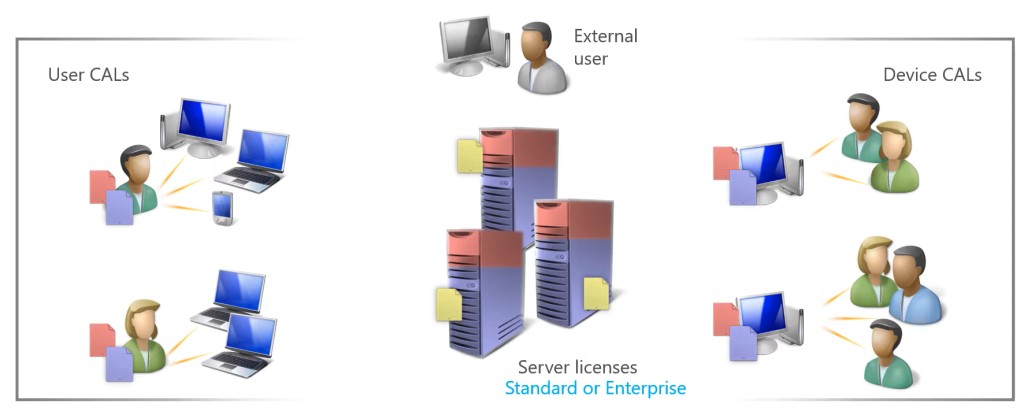
Server License + CAL
Purchase a Server license for each server, and then purchase Client Access Licenses (CALs) for either users or devices.
- Server License
- Exchange Server Standard License
- Exchange Server Enterprise License
- Client Access License (CAL)
- Exchange Server Standard CALs - User / Device
- Exchange Server Enterprise CALs - User / Device
- Exchange Server Enterprise CALs with Services - User / Device
- Exchange Server Enterprise CALs are only the additive CALs.
- Exchange Server Enterprise CAL and Exchange Server Enterprise CAL with Service can be added only to user / device with assigned Exchange Server Standard CAL.
License Rules
Server License
- Exchange Server Standard
- A single server license must be assigned to the physical server.
- Limited to 1-5 database/s per server.
Choose for small to midsize organizations with limited scalability requirements with fewer users.
- Exchange Server Enterprise
- A single server license must be assigned to the physical server.
- Limited to 1-100 database/s per server.
Choose for larger organizations with high scalability requirements with a large number of users, or for high availability within clustered environments.
Client Access License (CAL)
A Client Access Licenses (CALs) must be purchased for either users or devices.
- Exchange Server Standard CALs
- Email and calendar information.
- Exchange Server Enterprise CAL (additive)
- Unified Messaging.
- Integrated archiving functionality
- Information protection capabilities.
- Exchange Server Enterprise CAL with Services with active SA (additive)
- Same capabilities as Exchange Server Enterprise CAL.
- Additionally, includes the rights to Data Loss Prevention and Exchange Online Protection.
- Standard or Enterprise CALs can be used with either Standard or Enterprise Server editions.
- Choose the Server license based on the required scalability and the CALs based on the required functionality.
- Exchange Server Enterprise CAL is only the additive CAL.
- Exchange Server Enterprise CAL can be added only to user / device with assigned Exchange Server Standard CALs.
Client Access License (CAL) feature reference:
| Features | Standard CAL | Standard + Enterprise CAL |
|---|---|---|
| Email, calendar, contacts, and tasks | ✓ | ✓ |
| Outlook on the web (Internet Explorer, Firefox, Chrome, Safari, and Edge support) | ✓ | ✓ |
| Apps for Outlook and Outlook on the web | ✓ | ✓ |
| Site mailboxes2 | ✓ | ✓ |
| Role-based access control (RBAC) capabilities | ✓ | ✓ |
| Journaling | Per database | Per user/distribution list |
| Journal decryption | ✓ | |
| Retention policies | Default and custom | Default and custom |
| In-Place Archive2 | ✓ | |
| Multi-mailbox search | ✓ | |
| In-Place Hold2 | ✓ | |
| Information protection and control (IPC): transport protection rules, Outlook protection rules, Information Rights Management (IRM) search | ✓ |
License Mobility & Reassignment
- License Mobility is not available for Exchange Server.
- Licenses can be reassigned to servers no more frequently than once every 90 days.
- License Mobility across Server Farms IS benefit of Software Assurance.
License Suites
- Microsoft Core CAL Suite
Contains Exchange Server Standard CAL.
- Microsoft Enterprise CAL Suite
Contains Exchange Server Enterprise CAL with Services, Exchange Online Archiving for Exchange Server.
Software Assurance
- Exchange Server licenses purchased with Software Assurance have License Mobility across Server Farms rights which allows the reassignment of Server licenses to other physical servers in a server farm as often as required.
- An Exchange Server Enterprise CAL with Services with active Software Assurance includes the rights to Data Loss Prevention and Exchange Online Protection.
- Disaster Recovery Rights available to SA customers to use software for conditional disaster recovery purposes. For each Instance of eligible server software Customer runs in a Physical OSE or Virtual OSE on a Licensed Server, it may temporarily run a backup Instance in a Physical OSE or Virtual OSE on either, another one of its Servers dedicated to disaster recovery.
Licensing External Users
- External users are users who are not the licensee’s or its affiliates’ employees or on-site agents or contractors.
- External users are licensed by the Exchange Server license and there are no requirements for CALs or other licenses for these users.
Downgrade Rights
Customers can choose to deploy an earlier version and, downgrade edition form Enterprise to Standard.
| Licensed Product | Target Edition | Target Version |
|---|---|---|
| Microsoft Exchange Server Enterprise | Microsoft Exchange Server Standard Microsoft Exchange Server Enterprise | same or earlier |
| Microsoft Exchange Server Standard | Microsoft Exchange Server Standard | same or earlier |
Licensing Virtual Machines (VMs) / Containers
A Server license must be assigned to a single physical server which licenses Exchange Server to be run in either the physical operating system environment or a single virtual machine on that server.
Failover Scenarios
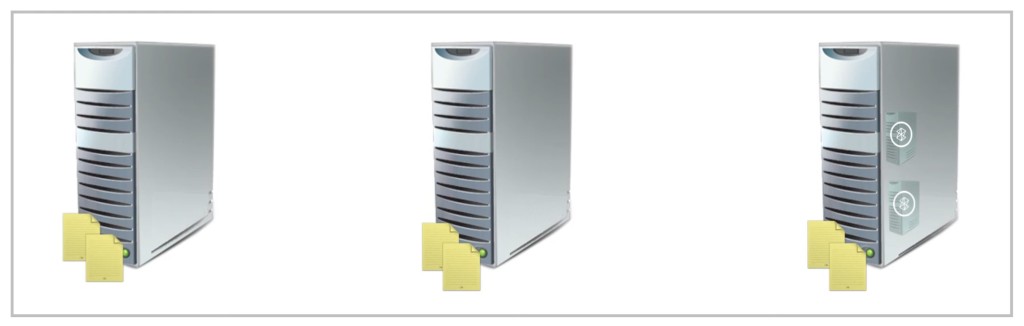
Server License without SA
- Assign Server license to a physical server to recieve rights to run the application in eather a physical or virtual operating system environment.
- The Server license must be assigned to each server in Server Farms for single Exchage Server in automatic failover scenario.
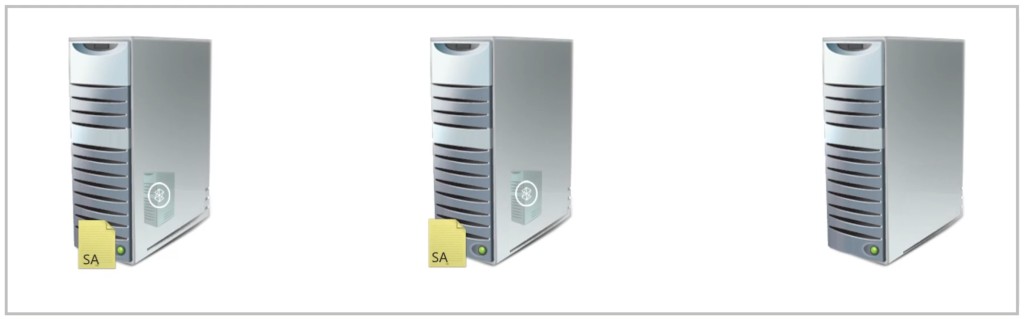
Server License with SA
- Assign Server license to a physical server to recieve rights to run the application in eather a physical or virtual operating system environment.
- Adding the Software Assurence (SA) to the license provides rights for License Mobility across Server Farms. So the Server license can be moved to another physical server as often as required.
Exchange Server Clients
Users have a choice of clients to access their Exchange mailbox:
- Microsoft Outlook
Is the corporate Exchange client, which is part of Office Standard or Professional Plus and can also be purchased standalone
- Outlook on the web
Enables users to access their Exchange mailbox from almost any web browser.
- Android / iOS Apps
Mail/Calendar/Outlook Apps for Android and iOS devices are available from the relevant stores.
Users accessing their Exchange mailbox in any of these ways must be licensed with the relevant Exchange Server CALs, dependent on the functionality they will be using.