MS Access Licenses
To access server software legally, a Client Access License (CAL) may be required. A CAL is not a software product, rather, it is a license that gives a user the right to access the services of the server. For using management software such as Microsoft System Center, a Management License (ML) may be required for the device being managed.
Individual Product Access Licenses
Windows Server
- Windows Server CAL - User / Device
- Windows Server Remote Desktop Services (RDS) CAL - User / Device
- Windows Server Active Directory Rights Management Services (ADRMS) CAL - User / Device
- Windows Server External Connector (for external users / devices)
Exchange Server
- Exchange Server Standard CALs - User / Device
- Exchange Server Enterprise CALs - User / Device
- Exchange Server Enterprise CALs with Services - User / Device
- Exchange Online Archiving for Exchange Server - ???
SharePoint Server
- SharePoint Server Standard CAL - User / Device
- SharePoint Server Enterprise CAL (Additive) - User / Device
Skype for Business Server
- Skype for Business Server Standard CAL - User / Device
- Skype for Business Server Enterprise CAL (Conference) - User / Device (additive)
- Skype for Business Server Plus CAL (Enterprise Voice + Telephony) - User / Device (additive)
Microsoft System Center
- Microsoft Endpoint Configuration Manager CML (SCCM) - OSE / User
- System Center Endpoint Protection SL (SCCM) - Device / User
- System Center Data Protection Manager CML (DPM) - OSE / User
- System Center Orchestrator (SCO) CML - OSE / User
- System Center Operations Manager CML (SCOM) - OSE / User
- System Center Service Manager CML (SCSM) - OSE / User
- Advanced Threat Analytics Client Management License (ML) !! TO Be CONFIRMED !!
- Microsoft Audit and Control Management Server CAL !! TO Be CONFIRMED !!
MS System Center - Link
Microsoft CAL Suite License
Like other CALs, CAL Suites can be licensed on either a per-user or per-device basis. CAL Suites simplify licensing and tracking by reducing the number of licenses that are necessary to access Microsoft servers. CAL Suites may also provide pricing that is more attractive than licensing the equivalent components individually. However, because a suite is a single license—the sum of individual CALs—CAL Suites cannot be split up among multiple users or devices; each CAL Suite is assigned for just one user or device.
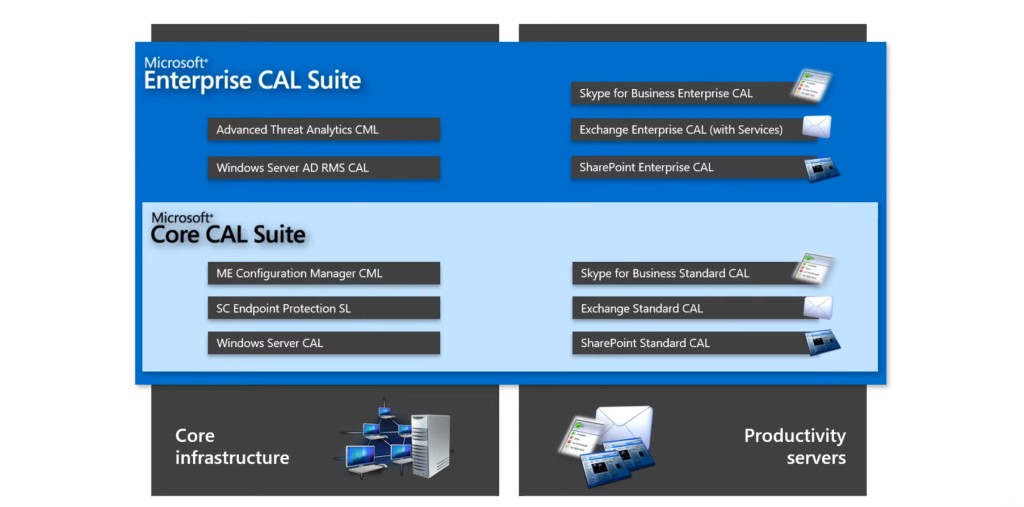
The Microsoft Server Client Access License (CAL) Suites consist of two offerings:
Microsoft Core CAL Suite
- Windows Server CAL
- Exchange Server Standard CAL
- SharePoint Server Standard CAL
- Skype for Business Standard CAL
- Microsoft Endpoint Configuration Manager Client Management License (formally System Center Configuration Manager)
- System Center Endpoint Protection Client Management License
- Skype for Business Server Standard CAL
Microsoft Enterprise CAL Suite
- All the components of the Core CAL Suite (listed above)
- Exchange Server Enterprise CAL with Services*
- Exchange Online Archiving for Exchange Server
- SharePoint Server Enterprise CAL
- Skype for Business Server Enterprise CAL
- Windows Server Active Directory Rights Management Services CAL
- Advanced Threat Analytics Client Management License
- Microsoft Audit and Control Management Server CAL
- Includes Data Loss Prevention and Exchange Online Protection
Microsoft CAL Suite Bridge License
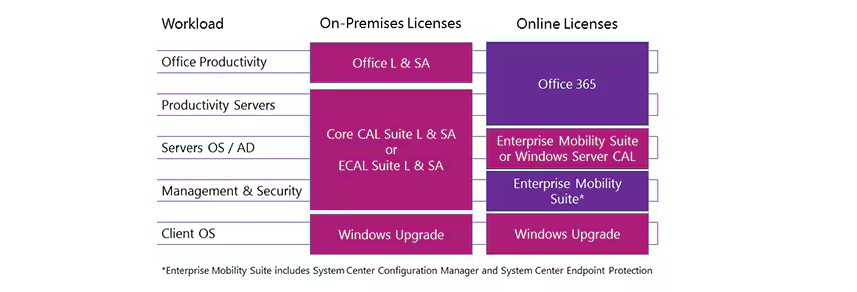
Microsoft Client Access License (CAL) Suite Bridges are used when you are transitioning from a CAL Suite (on premises) to a comparable Product and Online Service combination.
CAL Suite Bridges include Server CALs not found in the online service used in place of the CAL Suite. They allow existing CAL Suite customers to retain access rights to on-premises CAL Suite workloads, companywide commitment, and corresponding platform discounts for workloads that are on-premises.
Microsoft CAL Suite Bridge Licensing - Link
External sources
Microsoft Client Access License - Link